
Is Education Free in Australia? What Families Applying for Work or PR Visas Need to Know
If you are planning to move to Australia for work, or you are considering applying for permanent residency (PR), one of the biggest questions you may have is:
“Will my children’s education be free in Australia?”
The short answer is: it depends on your visa status, the state or territory where you live, and the type of education your child attends.
Australia has a strong public education system, but “public school” does not always mean “completely free for every visa holder.” Families on temporary visas may have to pay school fees, while Australian citizens and many permanent residents generally have access to government-funded public schooling subject to the relevant state or territory rules.
This guide explains the basics so families can plan their move with a clearer understanding of education and training costs.
Australia’s Education System
Australia’s education system generally includes:
- Early childhood and preschool education
- Primary school
- Secondary school
- Vocational Education and Training (VET/TAFE)
- University and higher education
- Adult and community education
- Workplace training
Education is managed differently across Australia’s states and territories. As a result, school fees and eligibility rules can vary depending on where your family lives, what visa you hold, your child’s age, school level, applicable state education policies, and any exemptions, subsidies or specific enrolment requirements that may apply to your circumstances before your child starts attending school.
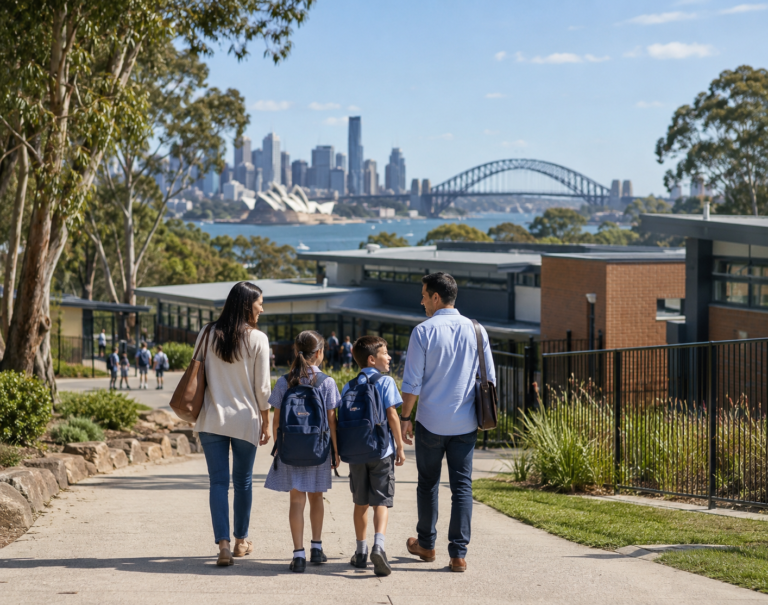
Is Public School Free in Australia?
For Australian citizens and many permanent residents, government (public) schools are generally provided without tuition fees.
However, families should understand that free public education does not necessarily mean that parents have no education-related expenses.
You may still need to budget for things such as:
- School uniforms
- Books and stationery
- School supplies
- Excursions and activities
- Transport
- Technology or devices, where applicable
- School camps and other optional activities
There may also be other costs depending on the school and state or territory.
What About Children of Temporary Visa Holders?
This is particularly important for families planning to come to Australia on a temporary work visa.
Temporary visa holders may be required to pay fees for their children to attend a government school.
The rules are not the same across Australia. Each state and territory has its own policies, fee structures and exemptions for different visa categories.
Therefore, you should not assume that your child will automatically receive free public schooling simply because you are living and working in Australia.
Before choosing where to live, check the education department in the relevant state or territory and confirm:
- Whether your visa permits your child to attend a public school.
- Whether school fees apply to your visa subclass.
- Whether any exemptions or concessions are available.
- Whether there are application or enrolment fees.
- What additional school costs you should expect.
Does Applying for PR Make Education Free?
This is another common misunderstanding.
Simply applying for permanent residency does not necessarily mean that your family’s visa status immediately changes to that of a permanent resident.
If you are still holding a temporary visa while your PR application is being processed, the education rules applicable to your current visa may continue to apply.
Your child’s eligibility and any applicable school fees should therefore be checked based on your actual visa status, not simply on the fact that you have submitted a PR application.
What Happens After You Become a Permanent Resident?
Once you become a permanent resident, your children’s access to government schooling can generally be much more similar to that of other eligible Australian residents.
However, education is administered by individual states and territories, so families should still check the current rules where they intend to live.
For instance If you are a Permanent Resident (PR) in Melbourne/Victoria, your minor/dependent child can attend a Victorian government (public) school without paying tuition fees. Victoria’s government states that government schools do not charge school fees, and permanent-resident dependants are eligible for government school funding.
What is free?
For a child of a PR holder attending a Victorian government school, the standard school curriculum and instruction are free. Schools must provide free access to curriculum-related instruction, facilities and required services.
It is important to remember that permanent residency does not make every form of education completely free.
Public school tuition is different from expenses such as uniforms, books, excursions, transport and extracurricular activities.
Private schools continue to charge tuition fees, regardless of whether a child is attending on a temporary or permanent basis.
Primary and Secondary School
School education in Australia generally covers:
Primary School
Primary school is the first major stage of formal schooling. Children develop foundational skills in areas such as:
- English
- Mathematics
- Science
- Health and physical education
- Languages
- Humanities and social sciences
- Technology
- The arts
The starting age and school structure can vary between states and territories.
Secondary School
Secondary education prepares students for further education, vocational training or employment.
Students generally study core subjects such as English, mathematics and science, while also having opportunities to choose elective subjects according to their interests and future plans.
What About Preschool and Childcare?
Preschool, kindergarten and early childhood education are different from compulsory school education.
These services are not necessarily free, and costs can vary considerably depending on the provider, location, child’s age and family’s circumstances.
Eligible families may be able to receive government assistance with certain approved early childhood education and care costs. However, eligibility depends on the relevant government rules and your circumstances.
Therefore, families moving to Australia should budget separately for childcare and preschool rather than assuming these services are free.
What About TAFE and Vocational Training?
Australia also has a large Vocational Education and Training (VET) sector, including TAFE institutions.
VET courses can provide practical training for many occupations without requiring a university degree.
However, VET and TAFE courses are not automatically free.
Course fees depend on factors such as:
- The course
- The state or territory
- Your residency or visa status
- Whether government funding applies
- Whether you qualify for a subsidy or fee-free training program
Some government-funded or subsidised training programs may be available to eligible students, but temporary visa holders should not assume that they qualify.
What About University?
Australian universities charge tuition fees, although the arrangements differ between domestic and international students.
Eligible domestic students may have access to government-supported arrangements such as HELP loans for certain higher education costs.
International students generally pay international student tuition fees unless they receive a scholarship or another form of financial support.
Therefore, university education should not be considered automatically free in Australia.
Private Schools Are Different
Private schools generally charge tuition fees.
Families may choose private schools for religious education, particular educational philosophies, facilities, curriculum options or other reasons.
Private school fees can vary significantly, so families should check the individual school’s current fee schedule before making a decision.
The Most Important Point for Migrant Families
If you are planning to apply for a work visa or PR and have school-aged children, do not calculate your migration budget on the assumption that public schooling will automatically be free.
Your potential education costs can depend on:
Visa type + state/territory + child’s age/year level + school type + applicable exemptions or subsidies
For example, two families with similar children may face different education costs simply because they hold different visas or live in different states.
Before Moving to Australia: A Simple Checklist
Before choosing a state or accepting a job offer, families should investigate:
- Your exact visa subclass
- Your child’s age and school year
- Public-school eligibility
- Applicable tuition or enrolment fees
- School uniform and book costs
- Transport costs
- Before/after-school care
- Preschool or childcare costs
- Private-school fees, if relevant
- VET/TAFE costs for older children or adults
- Possible government subsidies or concessions
Most importantly, check the current rules directly with the education department of the state or territory where you plan to live.
Final Takeaway
Australia offers a broad and high-quality education system, but education is not simply “free for everyone.”
For Australian citizens and many permanent residents, government schools generally provide tuition-free schooling, although families still have other school-related expenses.
For people on temporary work or other temporary visas, public-school fees may apply, depending on the visa and the state or territory.
And if you are applying for PR, remember that lodging a PR application does not automatically mean that you receive the same education entitlements as a permanent resident while your application is being processed.
Planning to Move to Australia?
If you are preparing for a work visa or PR application, understanding education costs before you choose your state, suburb and visa pathway can help you create a much more realistic family budget.
Always verify the current rules with the relevant Australian state or territory education authority and the Department of Home Affairs before making financial or migration decisions, because visa and education policies can change.
This article is intended for general public awareness and education. It is not immigration, legal or financial advice. Education eligibility and fees vary according to visa status, state or territory and individual circumstances.
Take the Next Step Toward Your Australian Future
Planning to move to Australia with your family? Your visa choice can affect more than just your work and residency options—it can also influence your children’s education costs, healthcare arrangements and overall family budget.
BCS Global can help you understand your potential Australian migration pathways and make more informed decisions based on your individual circumstances.
Whether you are exploring an employer-sponsored visa, skilled migration or a pathway toward permanent residency, our team can help you understand the requirements and next steps.
Ready to Explore Your Options?
Take the next step toward building your future in Australia.
👉 Get in touch with BCS Global today for a professional assessment of your potential migration options.