
Australia Work Visa from Dubai, UAE and the GCC Countries: Subclass 482 and Subclass 186 Visa Guide (2026–2027)
Published by BCS GLOBAL | Australian Work Visa and Employer Sponsorship Guidance
Are you living in Dubai or another part of the UAE or you living in GCC Country and planning to build your career in Australia? If you have relevant qualifications, professional skills and work experience, an Australian employer-sponsored visa may be worth exploring.
Australia offers visa pathways that allow eligible overseas workers to take up skilled employment with Australian businesses. Two important options are the Skills in Demand visa (Subclass 482) and the Employer Nomination Scheme visa (Subclass 186).
The Subclass 482 visa is a temporary employer-sponsored pathway, while Subclass 186 is a permanent residence visa for eligible applicants nominated by an Australian employer. Depending on your circumstances, Subclass 482 employment may also provide a pathway towards permanent residence through Subclass 186.
At BCS GLOBAL, we help prospective applicants understand these visa options, assess their profiles and prepare for the employer-sponsored visa process.
In this guide, we explain the key differences between these visas, the eligibility criteria, employer sponsorship requirements, documents, salary thresholds and the steps involved in applying from Dubai or elsewhere in the GCC Countries.
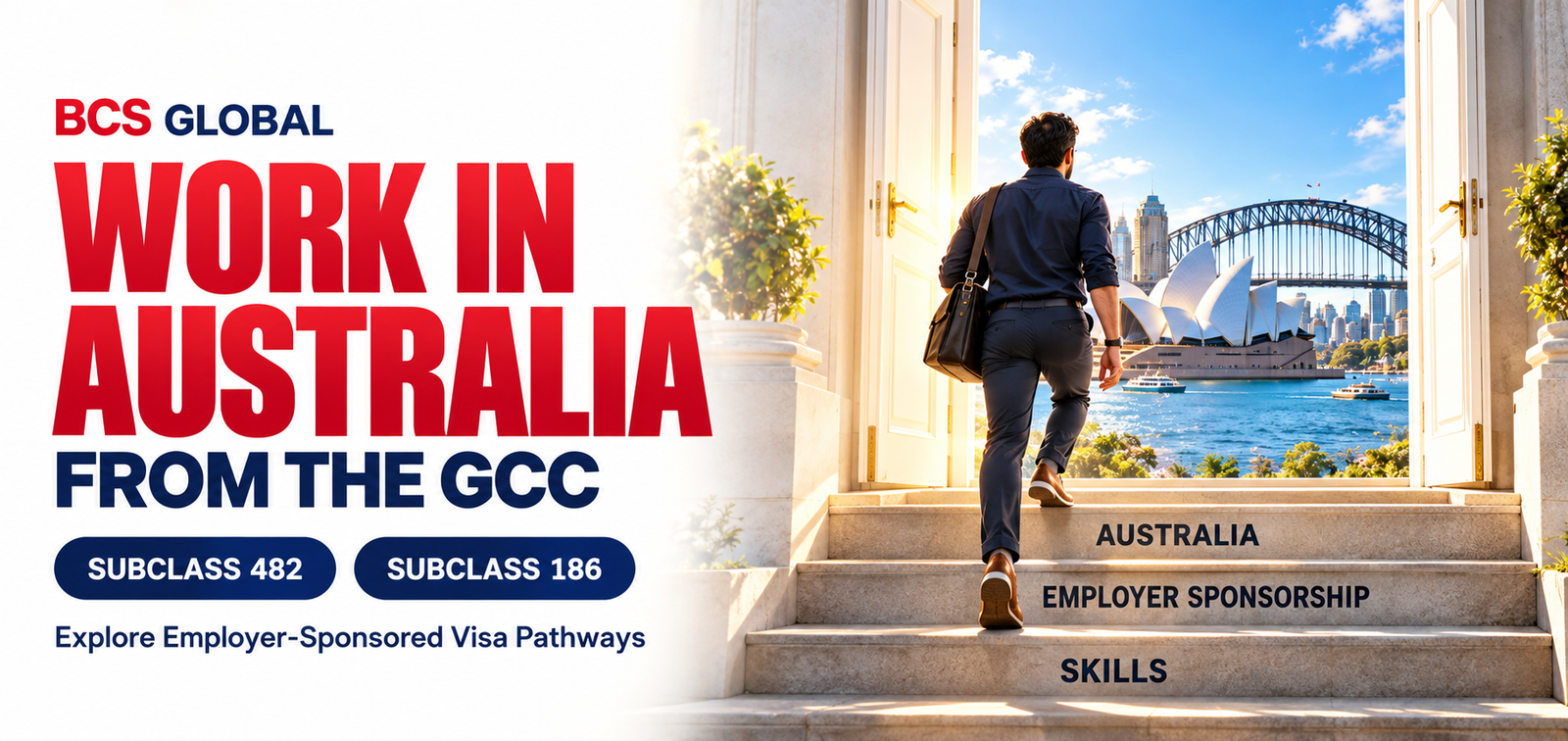
1. Understanding Australian Employer-Sponsored Visas
Australian businesses may recruit skilled workers from overseas when they need people with the skills and experience required for particular positions.
For eligible applicants living in the UAE and GCC Countries employer-sponsored migration can provide an opportunity to work in Australia in a nominated occupation.
The two principal visa options covered in this guide are:
Subclass 482 – Skills in Demand visa
This temporary visa allows an eligible Australian employer to sponsor a skilled worker for a nominated position. Depending on the stream and individual circumstances, the visa can generally be granted for up to four years.
Subclass 186 – Employer Nomination Scheme visa
This visa allows eligible skilled workers nominated by an Australian employer to obtain permanent residence. Applicants may qualify through different streams, depending on their work history, qualifications and circumstances.
The appropriate pathway depends on your occupation, employment background, English proficiency, qualifications, age where applicable and the availability of a genuine employer-sponsored position.
2. Subclass 482 Visa: Work in Australia Through Employer Sponsorship
The Skills in Demand visa (Subclass 482) replaced the former Temporary Skill Shortage visa on 7 December 2024.
It enables an approved Australian employer to sponsor an eligible overseas worker for a position that meets the applicable requirements.
For professionals living in Dubai, Abu Dhabi, Sharjah or elsewhere in the UAE or living in any of the 6 GCC Countries, this may be an option to investigate if their experience matches an occupation for which an Australian employer is willing and eligible to sponsor them.
Who may qualify for a Subclass 482 visa?
Although the final requirements depend on the applicable stream and occupation, applicants generally need to demonstrate the following:
- A genuine job offer and nomination from an eligible Australian employer.
- Relevant skills and qualifications for the nominated occupation.
- At least one year of relevant work experience in the nominated occupation or a related field, subject to the applicable rules.
- English language proficiency at the required level, unless an exemption applies.
- A suitable skills assessment, where required.
- Compliance with health and character requirements.
- Supporting documents that accurately establish their identity, employment history and qualifications.
Meeting these requirements does not automatically result in visa approval. The employer's sponsorship and nomination must also satisfy the relevant Australian immigration rules.
The three Subclass 482 streams
The Skills in Demand visa has three streams:
1. Core Skills stream
This stream generally requires the nominated occupation to appear on the applicable Core Skills Occupation List (CSOL). The salary must satisfy the relevant income threshold and annual market salary requirements.
2. Specialist Skills stream
This stream is intended for eligible highly paid skilled workers in specified occupation groups. The relevant occupation and salary requirements must be met.
3. Labour Agreement stream
This stream applies where an Australian employer has a relevant labour agreement with the Australian Government and nominates workers in accordance with that agreement.
Your occupation, proposed salary and employer's circumstances help determine which stream may be appropriate.
3. Subclass 482 Salary Requirements for 2026–2027
Salary is an important part of an employer-sponsored visa application. The employer must meet the applicable income threshold and demonstrate that the nominated worker will receive at least the required annual market salary rate.
For nomination applications lodged between 1 July 2026 and 30 June 2027, the published thresholds include:
| Visa stream or requirement | Income threshold |
|---|---|
| Core Skills Income Threshold | AUD 79,423 per year |
| Specialist Skills Income Threshold | AUD 146,576 per year |
These figures are the relevant income thresholds, not a guarantee of eligibility. The applicable occupation, stream, market salary rate and other requirements must also be satisfied.
The Core Skills Income Threshold also applies to relevant Subclass 186 nominations lodged from 7 December 2024.
Salary thresholds can change through annual indexation. Applicants and employers should confirm the current figures before proceeding.
Official reference: Australian Department of Home Affairs – Salary requirements for sponsored workers.
4. Subclass 186 Visa: A Pathway to Australian Permanent Residence
The Employer Nomination Scheme visa (Subclass 186) is a permanent visa for eligible skilled workers nominated by an Australian employer.
Unlike the temporary Subclass 482 visa, Subclass 186 is designed to provide permanent residence, subject to the applicant meeting all applicable requirements and receiving approval.
There are different streams under Subclass 186. Two important options are the Temporary Residence Transition stream and the Direct Entry stream.
Temporary Residence Transition stream
This stream may suit eligible workers who have already worked in Australia on a qualifying sponsored visa.
Applicants generally need to:
- Hold a qualifying Subclass 457, Subclass 482 or eligible bridging visa.
- Complete at least two years of eligible full-time sponsored employment in Australia within the relevant three-year period.
- Obtain nomination from an eligible Australian employer.
- Meet applicable age, English language, skills and other requirements, unless an exemption applies.
The qualifying employment and nomination requirements must be assessed against the rules in force when the application is lodged.
Direct Entry stream
The Direct Entry stream may be suitable for applicants who are nominated directly for permanent residence without first completing the Temporary Residence Transition pathway.
Depending on the circumstances, applicants generally need to demonstrate:
- An eligible occupation and employer nomination.
- Relevant qualifications, skills and work experience.
- A suitable skills assessment, unless exempt.
- Competent English, unless an exemption applies.
- Compliance with the applicable age, health, character and other visa requirements.
The Direct Entry stream has its own eligibility criteria. Applicants should not assume that qualifying for a Subclass 482 visa automatically means they qualify for Subclass 186 Direct Entry.
Official reference: Australian Department of Home Affairs – Employer Nomination Scheme visa (Subclass 186).
5. Subclass 482 vs Subclass 186: What Is the Difference?
Understanding the difference between these two visas is essential before choosing your migration pathway.
| Feature | Subclass 482 | Subclass 186 |
|---|---|---|
| Visa type | Temporary | Permanent |
| Employer nomination | Required | Required |
| Duration | Generally up to four years, depending on the stream | Permanent residence |
| Work experience | Generally at least one year of relevant experience, subject to applicable rules | Depends on the selected stream |
| Skills assessment | Required for certain applicants or occupations | Required for relevant applicants, including most Direct Entry applicants, unless exempt |
| English requirement | Applicable standard or exemption | Applicable standard or exemption |
| Potential PR pathway | May lead to Subclass 186 if eligible | Grants permanent residence if approved |
Which option is better for you?
There is no single answer for every applicant. Someone with a suitable Australian job offer may consider Subclass 482; while a person who meets the requirements for direct permanent employer nomination may be able to explore Subclass 186.
A profile assessment can help identify which route is worth pursuing before you commit to significant expenses.
6. Can You Apply for an Australian Work Visa from Dubai?
Yes. Eligible applicants can apply for the Subclass 482 visa from outside Australia, including from the UAE and GCC Countries. Subclass 186 applications may also be lodged from inside or outside Australia, subject to the applicable requirements.
Living in UAE OR GCC Countries does not, by itself, establish eligibility. Your occupation, experience, qualifications, English proficiency and proposed employment arrangement remain important.
A practical starting point is to review your professional profile and identify whether your skills match an occupation that an eligible Australian employer may be willing to nominate.
You should also consider whether your qualifications require assessment by a relevant Australian assessing authority and whether your English test results meet the requirements for your intended visa.
7. What Does an Australian Employer Need to Do?
Employer-sponsored migration involves obligations for both the employer and the applicant. Receiving a job offer alone is not sufficient.
Depending on the circumstances, the employer may need to:
- Become an approved sponsor: The business must have the appropriate sponsorship status or arrangement under the applicable visa stream.
- Identify a genuine position: The role must be genuine and meet the relevant occupation and employment requirements.
- Complete labour market testing: Where required, the employer must undertake the prescribed recruitment advertising and demonstrate compliance with the applicable rules.
- Submit the nomination: The employer provides information about the position, proposed salary, occupation and other required details.
- Meet salary and employment obligations: The nominated salary and employment conditions must comply with the applicable requirements.
The applicant must separately meet the visa criteria. Both sides need to provide accurate information and cooperate throughout the process.
Importantly, a job offer or sponsorship should never be treated as a guaranteed visa outcome.
8. Documents Required for an Australian Employer-Sponsored Visa
Your document checklist will depend on the visa subclass, occupation, employer and personal circumstances. Preparing the relevant evidence early can help reduce delays caused by missing information.
Commonly required documents include:
Personal identity documents
- Valid passport.
- National identity documents, where applicable.
- Evidence of any name changes.
- Marriage or birth certificates, where relevant.
Educational qualifications
- Degree, diploma or trade certificates.
- Academic transcripts.
- Professional registrations or licences, if required.
Employment evidence
- Employment reference letters stating job duties and employment dates.
- Employment contracts.
- Payslips and other salary evidence.
- Supporting records demonstrating relevant work experience.
Skills and English language evidence
- Skills assessment outcome, if required.
- Accepted English language test results, unless exempt.
- Evidence of professional registration, where applicable.
Health, character and family documents
- Health examination information, as requested.
- Police certificates, where required.
- Marriage and birth certificates for family members included in the application.
Employer documents
- Sponsorship details.
- Nomination information.
- Position and salary evidence.
- Other business or employment documents required by the Department of Home Affairs.
Documents that are not in English generally require appropriate English translations. Applicants should follow the Department's current document and translation instructions.
BCS GLOBAL recommends organising documents carefully and ensuring that all employment and qualification claims can be supported by genuine evidence.
9. Step-by-Step Process for an Australian Employer-Sponsored Visa
Although each case is different, the process can generally be organised into the following stages.
Step 1: Initial profile assessment
Review your qualifications, occupation, work history, English proficiency and other relevant details to identify a potentially suitable pathway.
Step 2: Identify a suitable employer-sponsored opportunity
Explore genuine employment opportunities that match your skills and professional background. An employer must be willing and eligible to sponsor the nominated position.
Step 3: Review the occupation and visa requirements
Confirm the applicable visa stream, salary requirements, skills assessment obligations and other eligibility criteria.
Step 4: Prepare the supporting documents
Collect your identity, qualification, employment, English language and other relevant evidence.
Step 5: Employer sponsorship and nomination
The employer completes the required sponsorship and nomination procedures, including labour market testing where applicable.
Step 6: Lodge the visa application
The applicant submits the relevant visa application and supporting documents in accordance with the Department's requirements.
Step 7: Respond to further requests
Complete health examinations, provide police certificates or other information when requested, and respond within the specified timeframes.
Step 8: Await the decision
The Department of Home Affairs assesses the application and makes the final decision. Processing times vary according to the application, its completeness and applicable processing priorities.
10. How Much Does an Australian Work Visa Cost?
There is no single total cost applicable to every applicant. Expenses depend on the visa subclass, the number of family members, the occupation, the assessing authority and the services required.
Potential expenses include:
- Government visa application charges.
- Skills assessment fees, where applicable.
- English language testing.
- Medical examinations.
- Police certificates.
- Certified translations and document preparation.
- Professional assistance fees, if engaged.
Employer-side sponsorship and nomination expenses may also apply. Australian law restricts the recovery of certain sponsorship-related costs from sponsored workers, so the employer and applicant should clearly understand their respective legal obligations.
Before committing to any service, request a written breakdown of the fees, what is included, what is excluded and when payments become due.
For current official government charges, visit the Department of Home Affairs fees and charges page.
11. How Long Does the Australian Visa Process Take?
Processing times depend on the visa subclass, the stream, the completeness of the application, employer-related requirements and the Department's current priorities.
A case may take longer if documents are missing, employment evidence needs verification, additional information is requested or the application requires further assessment.
Australian skilled visa processing priorities changed on 19 September 2026, when Ministerial Directions 121 and 122 replaced the earlier processing priorities under Direction 119. These directions establish processing priorities for specified temporary and permanent skilled visas.
Official reference: Australian skilled visa processing priorities.
No consultant or service provider can guarantee the date of a visa decision.
12. Can Your Family Accompany You to Australia?
Eligible applicants may be able to include qualifying family members in their visa application or arrange for eligible family members to join them later, subject to the rules for the particular visa.
Requirements can vary depending on the visa subclass, the relationship, the timing of the application and the circumstances of each family member.
Relevant documents may include marriage certificates, birth certificates, identity documents and health or character evidence.
If you plan to move to Australia with your spouse or children, consider the family arrangements during the initial planning stage. Confirm the applicable rules before lodging your application.
13. Important Points to Consider Before Applying
Before spending money on an Australian employer-sponsored visa, take time to evaluate the following:
- Your occupation: Confirm that your occupation is eligible for the intended visa stream.
- Your experience: Ensure your employment history is relevant and supported by genuine records.
- Your qualifications: Check whether a skills assessment or professional registration is required.
- Your English proficiency: Confirm the accepted test and required standard for your circumstances.
- The employer: Verify that the employment opportunity is genuine and that the employer can meet sponsorship obligations.
- Your finances: Understand the government charges, professional fees and other potential expenses.
- Your long-term plans: If permanent residence is your objective, assess the relevant Subclass 186 requirements instead of assuming that a temporary visa automatically leads to PR.
Never submit false employment letters, altered certificates or misleading information. Inaccurate or fraudulent documents can lead to refusal and potentially serious consequences for future visa applications.
14. How BCS GLOBAL Can Assist You
BCS GLOBAL supports individuals who want to explore Australian employer-sponsored work and permanent residence pathways.
Our focus includes the Subclass 482 Skills in Demand visa and Subclass 186 Employer Nomination Scheme visa.
Depending on your requirements and the agreed scope of service, our support may include:
- Reviewing your professional background and relevant documents.
- Discussing potential visa pathways based on your profile.
- Helping you understand the occupation, experience and English language requirements.
- Assisting with document preparation and organisation.
- Explaining the employer sponsorship and nomination process.
- Helping you understand the relevant stages of the visa application.
- Providing guidance on the requirements that may apply to a future Subclass 186 application.
The services available in an individual case will depend on your circumstances and the written service agreement. Any immigration advice that Australian law requires to be provided by an authorised professional should be obtained from an appropriately authorised Australian migration professional or legal practitioner.
Our objective is to help clients make informed decisions, understand the process and prepare their applications responsibly.
Frequently Asked Questions (FAQs)
1. Can I apply for an Australian work visa while living in Dubai or GCC Countries?
Yes. Eligible applicants can apply for an employer-sponsored Subclass 482 visa from the UAE or GCC Countries. Subclass 186 may also be available to eligible applicants applying from outside Australia. You must satisfy the requirements for the relevant visa.
2. Is a job offer compulsory for the Subclass 482 visa?
An eligible nomination from an Australian employer is required. A job offer by itself is not sufficient; the employer, nominated position and applicant must meet the applicable requirements.
3. What is the difference between Subclass 482 and Subclass 186?
Subclass 482 is a temporary employer-sponsored visa, generally granted for up to four years depending on the stream. Subclass 186 is a permanent residence visa for eligible applicants nominated by an Australian employer.
4. Can I obtain permanent residence after a Subclass 482 visa?
Potentially, yes. Eligible Subclass 482 holders may be able to apply for Subclass 186 through the Temporary Residence Transition stream after completing the required period of qualifying sponsored employment and meeting the other criteria. Permanent residence is not automatic.
5. How much work experience do I need for Subclass 482?
The general work experience requirement is at least one year in the nominated occupation or a related field. Other occupation-specific, stream-specific and visa requirements may also apply.
6. Do I need IELTS for an Australian work visa?
Not necessarily IELTS specifically. Applicants generally need to meet the applicable English language requirement unless an exemption applies. The accepted tests and required scores depend on the visa rules in force.
7. What is the minimum salary for Subclass 482 in 2026–2027?
For nominations lodged from 1 July 2026 to 30 June 2027, the Core Skills Income Threshold is AUD 79,423, while the Specialist Skills Income Threshold is AUD 146,576. The relevant threshold depends on the stream, and the annual market salary requirement must also be satisfied where applicable.
8. Can I include my spouse and children?
Eligible family members may be included in an application or may qualify to join the primary applicant later, subject to the relevant visa rules and requirements.
9. How long will my visa application take?
There is no universal processing time. The timeframe depends on the visa, application completeness, employer-related requirements and current Department of Home Affairs priorities.
10. Does BCS GLOBAL guarantee a job or visa approval?
No responsible service provider should promise a guaranteed visa outcome. Employment depends on genuine opportunities and employer selection, while the Australian Department of Home Affairs makes the final visa decision. Any services and commitments should be clearly documented in the service agreement.
Conclusion: Explore Your Australian Work Visa Options with BCS GLOBAL
For skilled professionals living in Dubai and across the UAE, Australia may offer opportunities to develop a career and, where eligible, work towards permanent residence.
The Subclass 482 and Subclass 186 visas serve different purposes. The right option depends on your occupation, professional experience, qualifications, English proficiency and employer sponsorship arrangements.
A careful review of your circumstances before beginning the process can help you understand the requirements, identify potential challenges and prepare the necessary documents.
Planning to work in Australia? Contact BCS GLOBAL to discuss your profile and explore the Subclass 482 or Subclass 186 pathway that may be suitable for your circumstances.
Disclaimer: This article is for general information only and is not legal or migration advice. Australian immigration laws, eligibility criteria, salary thresholds, government charges and processing priorities can change. Eligibility and outcomes depend on the individual circumstances and the rules applicable at the time of application. Always check official Department of Home Affairs information and obtain appropriate professional advice before proceeding.
About BCS GLOBAL
BCS GLOBAL assists prospective applicants in understanding and preparing for Australian employer-sponsored visa pathways, with a focus on Subclass 482 and Subclass 186. Contact our team to discuss your circumstances and the support available for your case.
We Always Give The Best For You
🌐 For more details and the latest updates, follow us on:
📘 Facebook | 📸 Instagram | 💼 LinkedIn | 🐦 X (Twitter)